

In the spring of 2020, as COVID-19 shut down offices across the country, most outpatient mental health clinicians moved their practices to telehealth. In addition to serving a stressed nation dealing with the uncertainty of COVID-19 came a hope that telehealth would finally reach the people the system has always struggled to serve. Those included rural patients far from the nearest clinician, people who can’t take an afternoon off for an appointment, and residents of states with too few providers.
Three years after the federal public health emergency ended, telehealth is still how most patients in the Headway network get care. From 2023 through 2025, 77.6% of outpatient visits were held virtually, and that share fell only slightly each year. Whether telehealth has delivered on access is a harder question. Our new peer-reviewed study, published in Telemedicine and e-Health with Jonathan Cantor of RAND and Christopher Whaley of Brown University, suggests the answer depends on which gap you evaluate.
About the study
We studied 28.8 million outpatient visits by 1.8 million commercially insured patients ages 6 to 64. We compared how often care was virtual or in-person by patient age, diagnosis, clinician type, state, and whether patients lived in a rural or urban location.
Mental health care visits are often a good fit for telehealth. Mental health care has relied on telehealth more than any other area of medicine. Among commercially insured patients nationally, mental health conditions were the top diagnosis for telehealth, accounting for 63% of patients with a telehealth claim in April 2025, according to FAIR Health. Among patients in traditional Medicare, telehealth accounted for 44% of behavioral health visits as of mid-2024, compared with just 9% of primary care visits, according to a University of Michigan analysis published in Health Affairs Scholar.
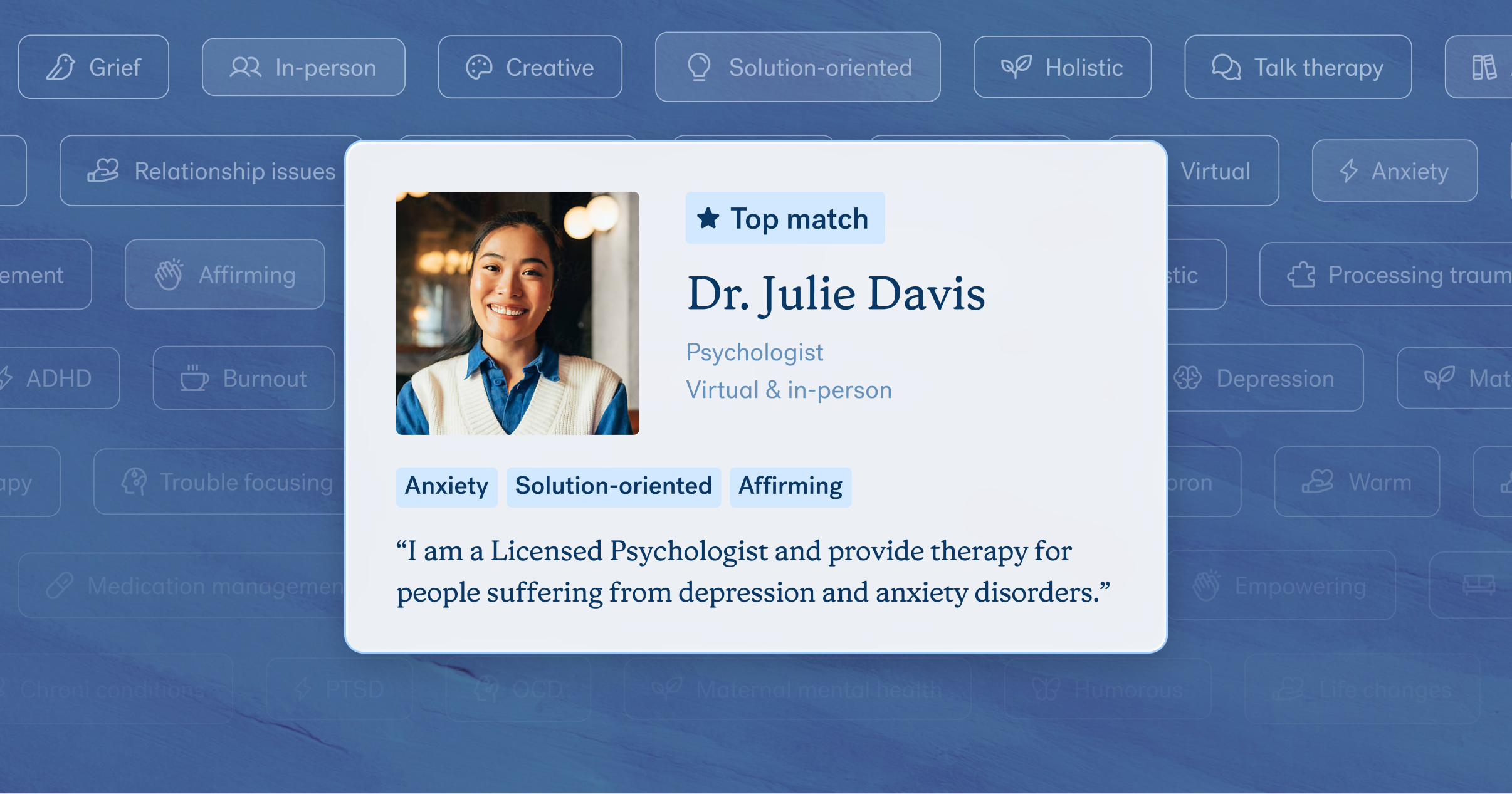
While nearly every clinician in our network offers access to telehealth, almost half also offer access to in-person care. That makes the data useful for answering a specific question: when patients can choose between clinicians who offer telehealth visits, in-person care, or both, which do they choose?
Most visits are still virtual, and in-person care is slowly returning
The share of visits held virtually fell slightly each year, from 79.7% in 2023 to 78.5% in 2024 and 76.2% in 2025. Over the same period, the share of clinicians who saw patients in-person rose slightly, from 40.6% to 42.3%. We also found that virtual care cost patients a little less out of pocket: about $30 vs. $33 per therapy visit, and $44 vs. $47 per psychiatry visit.
One concern about telehealth has been that it would mainly serve patients with milder symptoms. We didn’t find that. Patients who started care virtually were just as symptomatic at their first visit as those who started in-person, with nearly identical average scores on depression and anxiety measures.
Christopher Whaley, PhD, a health economist at Brown University and co-author of the study, had this to say about what it means:
“For years, the worry was that telehealth would widen the gap between people who can easily get to care and people who can’t, particularly for those who are sicker. When the option is available and covered, it can reach people for whom getting to an office is a real obstacle. The next question is whether that holds for people with Medicaid or no insurance at all.”
Telehealth has not closed the rural gap
Surprisingly, rural patients used telehealth less often than urban patients in every year and at every age. Overall, 70.3% of rural patients’ visits were virtual, compared with 77.5% for urban patients. The gap was widest for patients in their 20s, but it has narrowed over time, from 9.5 percentage points in 2023 to 6.8 points in 2025.
The variation by state was even larger, ranging from 54% of visits held by telehealth in Kansas to about 89% in New York, Hawaii, and Washington, DC. Some of the states with the fewest mental health clinicians had the lowest use of telehealth, which is the opposite of what telehealth was supposed to accomplish. Those are the places where telehealth visits have the potential to be most impactful, because a local in-person appointment may not be available.
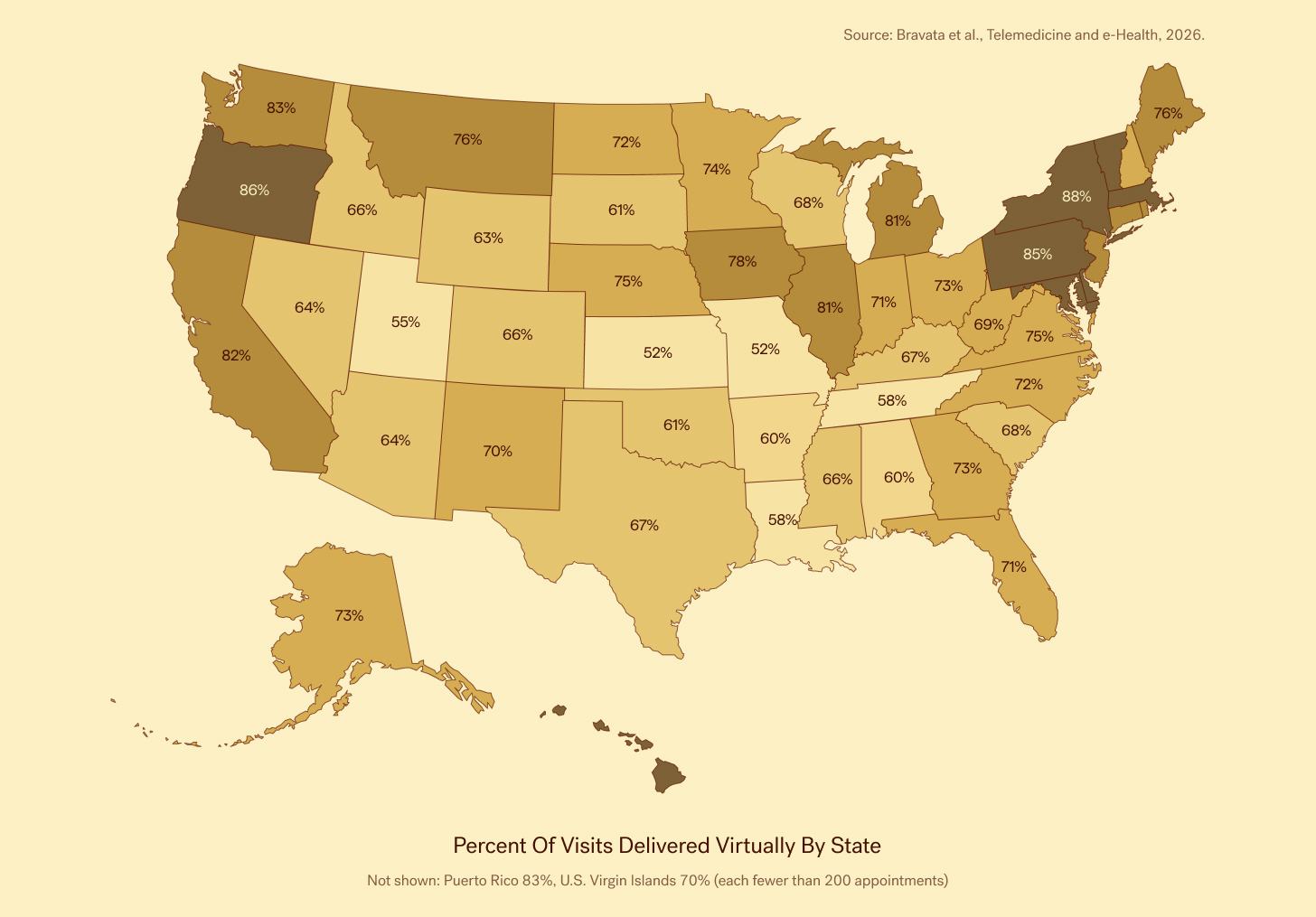
Clinicians in our network offered telehealth, so in theory technology shouldn’t have been a barrier. The lower use in rural areas suggests that in practice it may have been, whether because of internet access, comfort with technology, or something else. State policy and local practice patterns may also play a role. Our data can’t separate these explanations.
Jonathan Cantor, PhD, a health economist at RAND and co-author of the study, put the rural finding this way:
“Three years after the public health emergency ended, rural patients are still less likely to use it than urban patients. The gap is narrowing, which is encouraging. But the results show that technology alone is not enough to close it. Decisions about payment, licensure, and broadband will also determine whether telehealth actually reaches rural patients.”
Young children are mostly seen in-person, especially for therapy
Only 37% of visits for children ages 6 to 12 were virtual, compared with 54% for teens and 77% for young adults aged 18 to 24. Virtual care peaked among patients in their late 20s and early 30s, then declined gradually with age.
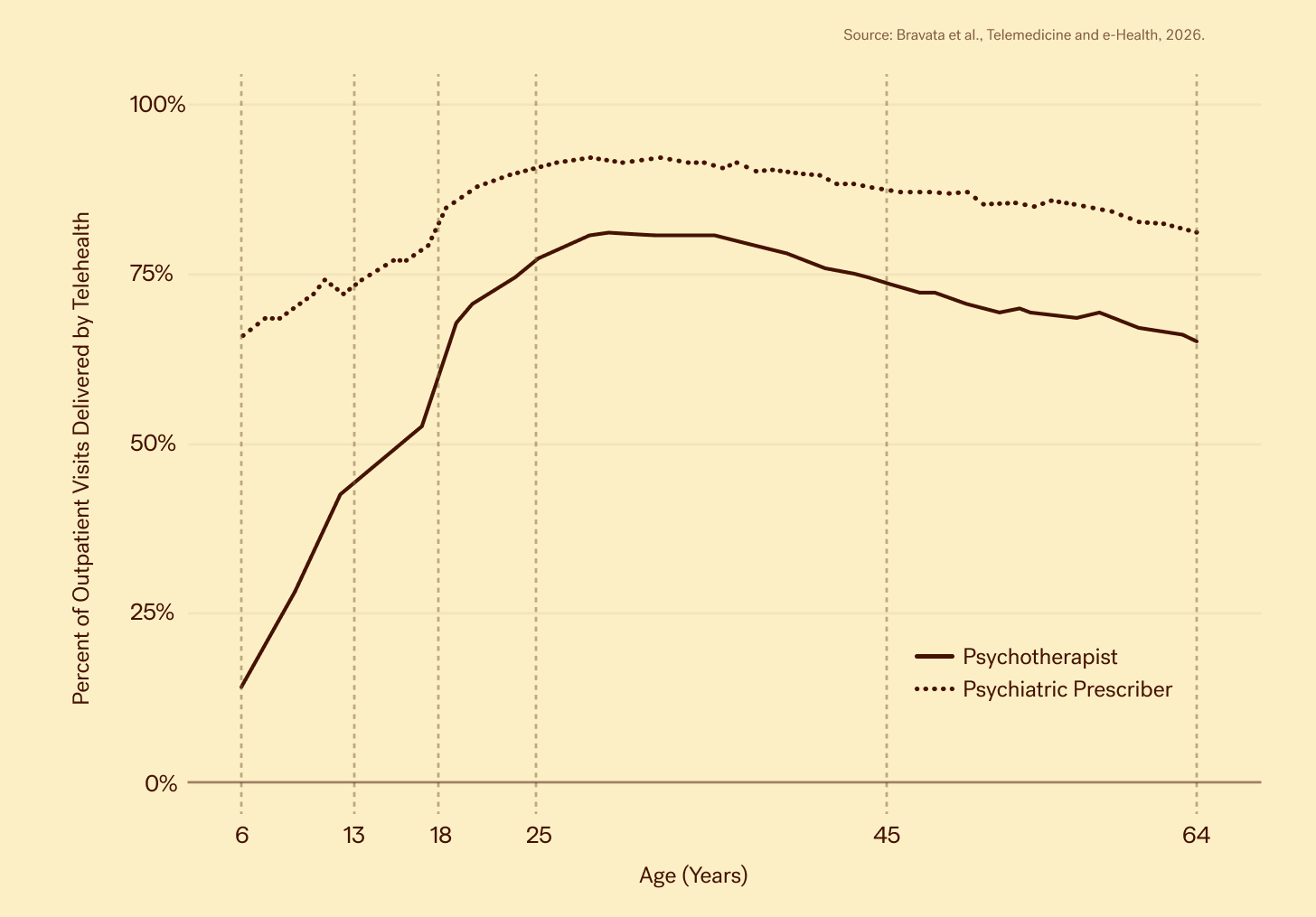
Most of that age difference came from therapy visits. For the youngest children, most psychiatry visits were still virtual, while most therapy visits were in-person. That makes sense clinically. Therapy with a seven-year-old often involves play, a parent in the room, and keeping a child engaged for most of an hour, which is hard to do through a screen. There is a well-documented shortage of child and adolescent psychiatrists: about 14 per 100,000 children nationally, and 70% of U.S. counties have none, according to the American Academy of Child and Adolescent Psychiatry. Telehealth may be helping more families reach the psychiatrists and nurse practitioners who are able to offer medication management for their children if needed.
This has practical consequences for how access gets counted. A network can look well staffed on paper because of its telehealth clinicians while families with young children still struggle to find someone to see in-person.
Patients often start in-person and switch to video, especially with prescribers
Visits with clinicians who prescribe medication, such as psychiatrists and psychiatric nurse practitioners, were held by telehealth 90.4% of the time, compared with 75.7% for psychotherapists. Both groups of clinicians moved toward virtual care as treatment went on, but at different speeds. Psychiatric clinicians shifted quickly after about the third appointment, while therapists shifted gradually. First visits were less likely to be virtual than follow-ups (74.3% vs. 77.9%). About 44% of clinicians offered both options, and 15% of patients saw their clinician both in-person and by video.
About a quarter of first visits were in-person, and that share fell as treatment went on. This suggests some patients and clinicians prefer to meet face to face at the start, while they build trust and agree on a treatment plan, and are comfortable moving to video once that’s in place.
That pattern is particularly relevant as federal rules on telehealth prescribing may change at the end of this year. The Drug Enforcement Administration (DEA) and Department of Health and Human Services (HHS) have extended the pandemic-era rules that allow clinicians to prescribe controlled substances by telemedicine without an in-person visit. That extension runs through December 31, 2026, according to the federal rule published in December 2025, and a permanent framework hasn’t been finalized. Although our study did not look specifically at controlled substance prescribing, the number of patients receiving care by telehealth suggests that ending these flexibilities could become a barrier to care for many of them.
What payers, policymakers, and care networks can do
Telehealth is now a permanent part of mental health treatment. The gaps it hasn’t closed will need deliberate work from the people who pay for, regulate, and deliver care.
Payers and regulators should measure in-person capacity separately when they assess whether a network has enough clinicians to meet patients’ needs (what regulators call network adequacy), especially for children and families.
Policymakers have the clearest levers for closing the rural gap: making it easier for clinicians to practice across state lines, broadband investment, and setting payment rules that make it viable for clinicians to serve rural patients. Any changes to telehealth prescribing rules and to other pandemic-era flexibilities should reflect how patients actually move between in-person care and telehealth over the course of treatment.
Care networks and platforms should track who uses telehealth and in-person care by age, rural or urban location, and state, the same way they track wait times. They should also make in-person options easy to find and support patients for whom telehealth isn’t a good fit or who find it difficult to use. At Headway, patients can search for clinicians who offer in-person care, virtual care, or both, and what they choose informs how we build our network. Right now that means a particular focus on adding clinicians in places where access is still limited, including rural areas.
Read the full paper
You can read the full paper, including state-by-state results and trends by diagnosis and appointment number, in Telemedicine and e-Health.